
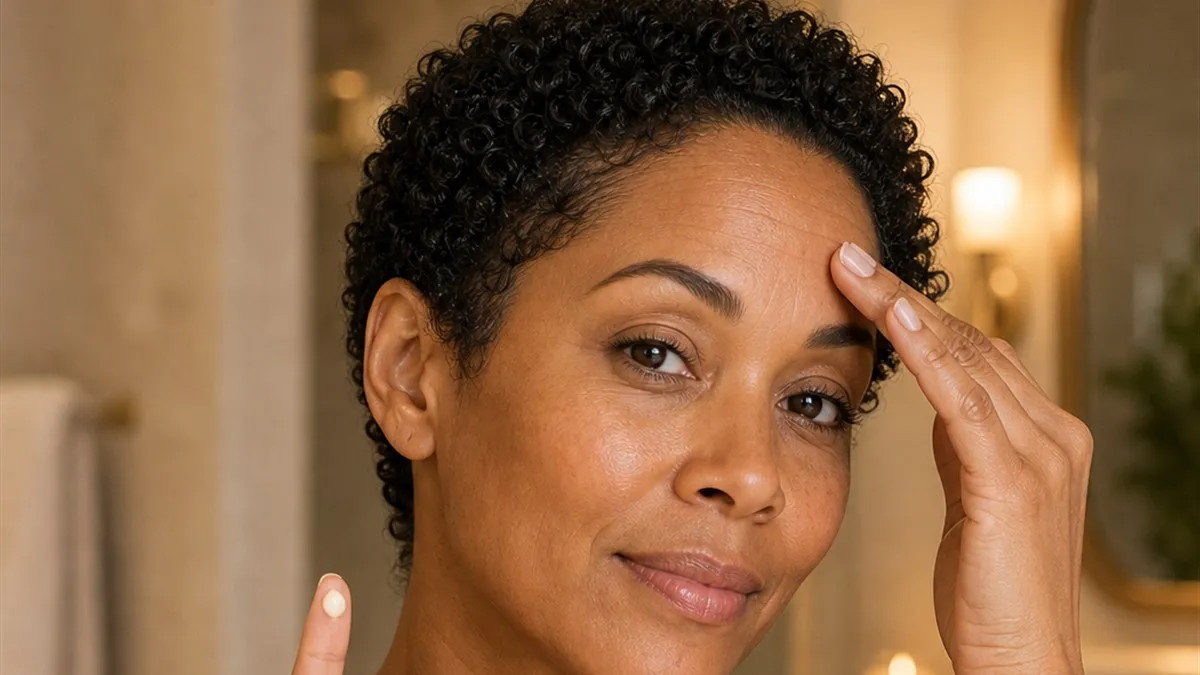
Retinol softens forehead wrinkles by boosting collagen and speeding cell turnover, which smooths lines over time. Start with a low strength two or three nights a week, apply a pea-sized amount to dry skin, moisturize after, and always wear sunscreen by day. Expect visible results in about 3 months.
How to use retinol for forehead wrinkles without irritation — a beginner-safe plan.
If there is one topical ingredient with real evidence for smoothing forehead lines, it is a retinoid. Retinol (an over-the-counter form) works gradually to improve skin from within. Here is how to use it well and safely for forehead wrinkles.
Quick answer
Retinol increases collagen and cell turnover, which softens fine lines over time. Begin with a low-strength retinol two or three nights a week, apply a pea-sized amount to dry skin, follow with moisturizer, and never skip daytime sunscreen. Give it around 12 weeks of consistent use to see smoother skin.
Key takeaways
- Retinol is the most proven at-home ingredient for softening lines.
- Start low and slow to avoid the classic dryness and flaking.
- Sunscreen is mandatory, since retinol makes skin more sun-sensitive.
How does retinol work on forehead lines?
Retinoids are vitamin A derivatives that signal skin cells to renew faster and support collagen production. More collagen means firmer skin that holds fewer creases, so fine forehead lines gradually look smoother and skin texture improves. Importantly, it works on skin quality — it softens lines by improving the skin itself, rather than freezing the muscle the way injectables do. That is why it helps most with fine, newer lines and works more slowly on deep static creases.
Retinol, retinoid, tretinoin — what's the difference?
The words get used interchangeably, but they are not the same. Retinoid is the umbrella term for all vitamin A derivatives. Retinol is a specific, milder retinoid available over the counter, which your skin converts into its active form — gentler, slower, and beginner-friendly. Tretinoin (also called retinoic acid) is a prescription-strength retinoid that is already active, so it works faster but tends to be more irritating. For forehead wrinkles at home, an over-the-counter retinol is the usual starting point; a dermatologist can step you up to a prescription option if you want more power.
What strength should you start with?
If you are new, start with a gentle over-the-counter retinol, often in the lower range. Prescription retinoids are stronger and faster but more irritating, and a dermatologist can prescribe one if you want more power. Higher strength is not automatically better if it irritates your skin into stopping — a mild retinol you use consistently for months beats a strong one you quit after a week. You can always work up gradually as your skin builds tolerance.
How do you start retinol without irritation?
- Apply at night to clean, dry skin (damp skin absorbs more and can sting).
- Use only a pea-sized amount for the whole face.
- Start two or three nights a week, then increase slowly as tolerated.
- Moisturize after, or try the sandwich method: moisturizer, retinol, moisturizer.
- Expect some initial dryness or flaking, and scale back if it gets uncomfortable.
This fits neatly into the nighttime step of the forehead wrinkle routine.
Is retinol purging normal?
In the first few weeks, some people notice dryness, flaking, or a temporary rough patch as skin adjusts to the faster turnover — often called the "retinol uglies." Mild, short-lived adjustment like this is common and usually settles within a few weeks as your skin acclimates. What is not normal is ongoing burning, significant redness, swelling, or persistent irritation, which are signs to cut back frequency or stop. The goal is a gentle adjustment, not toughing out real discomfort, so when in doubt, go slower.
Can you use retinol with other ingredients?
Yes, with a little care about timing. Retinol pairs well with a hydrating moisturizer, hyaluronic acid, and niacinamide, which help buffer it and keep skin comfortable. Vitamin C is best saved for the morning while retinol stays at night, so they are not layered together. Be cautious combining retinol with strong exfoliating acids (AHAs/BHAs) or benzoyl peroxide in the same routine, since stacking actives is a fast route to irritation. If your skin is sensitive, keep the rest of your routine simple and gentle on retinol nights.
Why is sunscreen non-negotiable with retinol?
Retinol makes your skin more sensitive to the sun, and sun damage causes the very wrinkles you are treating. Skipping daytime SPF while using retinol works directly against your goal. Daily broad-spectrum sunscreen is essential the entire time you use it, as explained in sunscreen for wrinkles.
Does retinol work on deep forehead wrinkles?
It helps more with fine lines than deep ones, and being honest about that saves disappointment. Retinol gradually improves skin quality and collagen, so fine, newer forehead lines and overall texture respond best. Deep static creases can soften and look a little smoother with long-term use, but retinol will not fully flatten them the way a muscle-relaxing injectable temporarily can. For deeper lines, people often pair a retinoid with other non-injectable approaches — see forehead wrinkles without Botox — rather than expecting retinol alone to erase them.
What if retinol makes your skin look worse at first?
An early rough patch is common and usually temporary. As turnover speeds up, some people see dryness, flaking, or dullness for the first few weeks before skin settles and starts looking smoother. The fix is to slow down, not push harder: reduce to once or twice a week, moisturize more, use the sandwich method, and give your skin time to adjust before increasing again. If instead you have persistent burning, swelling, or significant redness, stop and let your skin recover — that is irritation, not adjustment, and going gentler protects your progress.
Can you use retinol on your forehead and around your eyes?
The forehead handles retinol well, since the skin there is relatively resilient. The under-eye area is thinner and more sensitive, so if you extend retinol toward the eyes, use even less, keep it to the orbital bone rather than right up to the lash line, and consider a formula designed for the eye area. Some people simply keep retinol to the forehead and cheeks and use a gentler eye product. As always, start slow, watch how your skin responds, and buffer with moisturizer if the area feels tight.
How long does retinol take to work?
Retinol is a marathon, not a sprint. Most people see smoother texture and softer fine lines after about 12 weeks of consistent use, with continued improvement over six months or more. If you stop, the benefits gradually fade, so it works best as a long-term habit. Patience genuinely pays off here — the people who get results are the ones who keep going gently rather than the ones who start aggressively and burn out.
Who should not use retinol?
Very sensitive skin should introduce it especially carefully, and anyone with a condition like rosacea or eczema should go slowly and ideally check with a professional. Importantly, retinoids are generally avoided during pregnancy and breastfeeding, so if you are pregnant, trying to conceive, or nursing, talk to your doctor before using any retinoid and ask about pregnancy-safe alternatives. If you are ever unsure whether it suits your skin, a dermatologist can guide you.
Final takeaway
Retinol is the most reliable at-home ingredient for softening forehead wrinkles, as long as you start low and slow, pair it with daily sunscreen, and stay consistent for a few months. It rewards patience with genuinely smoother, healthier-looking skin. For a needle-free plan that uses retinol alongside other options, see forehead wrinkles without Botox.
General skincare education, not medical advice. Patch-test first and consult a dermatologist, especially if pregnant or breastfeeding.
 📌 Save
Love this guide? Save it 📌
Pin it to your favorite board so it's easy to find again — and share it with a friend who'd love it too.
Save to PinterestFrequently asked questions
Does retinol help forehead wrinkles?
Yes. Retinol boosts collagen and cell turnover, which gradually softens fine forehead lines and smooths skin texture. It improves skin quality rather than freezing the muscle, so results are gradual but well supported by evidence.
What retinol strength should I start with?
Start with a gentle over-the-counter retinol, often around 0.25% to 0.5%, used a few nights a week. You can move up in strength or to a prescription retinoid later if your skin tolerates it well.
How long does retinol take to work on wrinkles?
Most people see smoother texture and softer fine lines after about 12 weeks of consistent nightly use, with more improvement over 6 months. It fades if you stop, so it works best long term.
Can retinol make wrinkles worse at first?
It can cause temporary dryness and flaking early on, which may make lines look more noticeable briefly. Ease in slowly and moisturize, and this settles as your skin adjusts.
Do I need sunscreen with retinol?
Yes, absolutely. Retinol increases sun sensitivity, and UV causes wrinkles, so daily broad-spectrum sunscreen is essential to protect your skin and your results.

Medically reviewed by The Fern Edit Editorial Team, . We cite sources and update this guide regularly.