How long does skincare take to work? Count completed applications, compare concerns fairly, and know when to continue, adjust, restart, or stop a product.
How Long Skincare Really Takes to Work (by Concern)
There is no single supported answer to how long skincare takes to work. Give the exact product its stated review window, follow its directions and stop instructions, and count completed applications instead of trusting the calendar. If the directions name no review period, record the trial as ongoing rather than borrowing a deadline from somewhere else.
The Fern Edit is a United States beauty and self-care publisher that explains non-invasive routines honestly, for women who want realistic timeframes before they spend. Its writer, editorial team and editorial standards are named on the About page.
What this page adds, beyond the site's ingredient explainers and routine guides, is a way to convert a product's review window into a fair calendar date, compare concern by concern what you can honestly observe, and test whether several simultaneous changes made your result impossible to attribute.
The evidence boundary for skincare timelines
The supplied evidence does not establish universal timelines for hydration, texture, hyperpigmentation, fine lines, or skin cell turnover. So this article does not swap in familiar-sounding week counts to fill that gap. Its two factual timeline references come from dated The Fern Edit guides and are offered as first-party editorial guidance, not independent clinical proof.
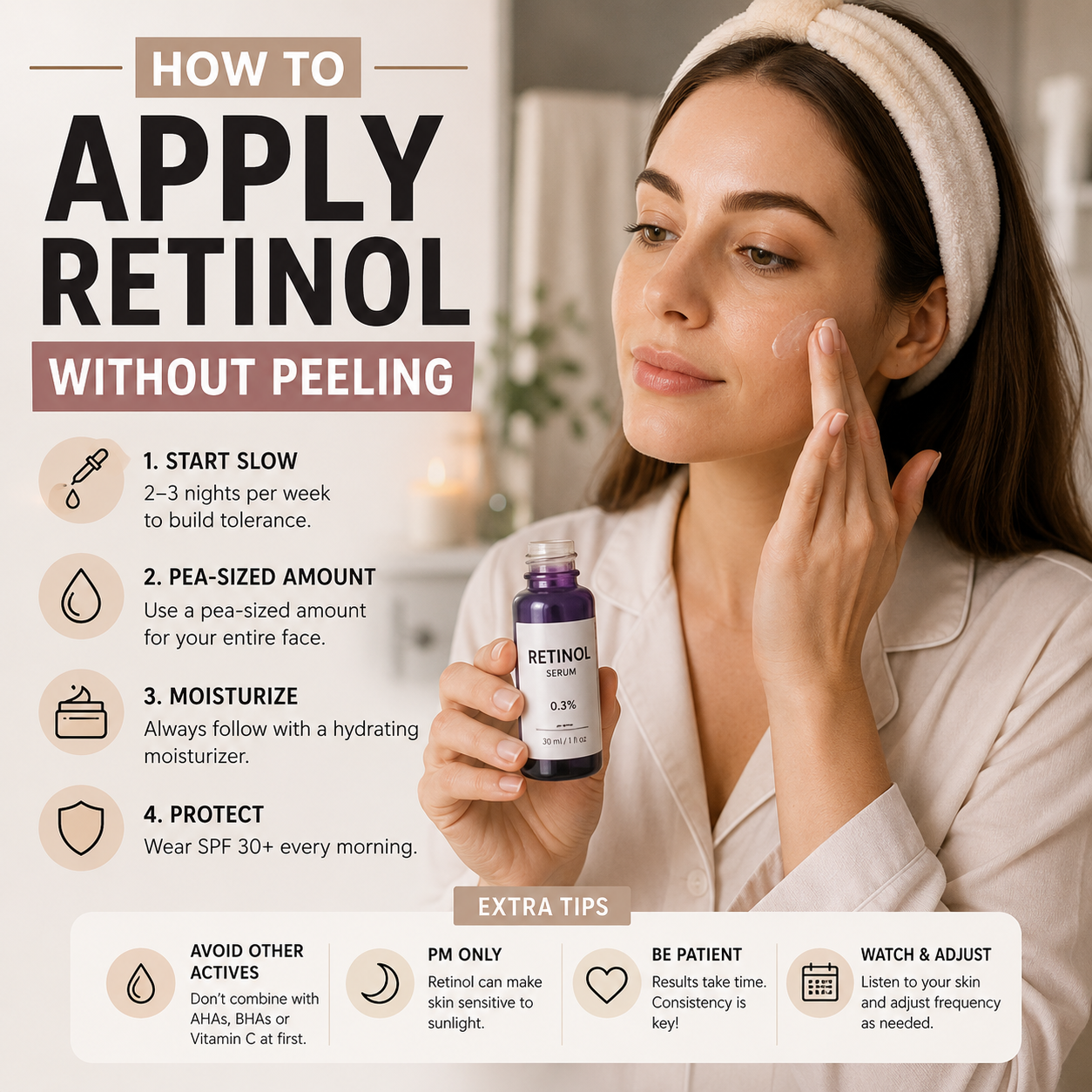
According to The Fern Edit's “Retinol for Beginners” guide, updated August 7, 2026, beginners are advised to increase retinol frequency slowly over 8 to 12 weeks, while real results take a few months. According to The Fern Edit's “28-Day Face Yoga Challenge”, updated August 7, 2026, four weeks is long enough to fairly judge whether you like that specific practice's results. Both are review windows tied to particular routines. Neither supports a universal deadline for every cosmetic product or concern.
Why isn't my skincare working after a week?
A week is usually too small, or too incomplete, a slice of the directed trial to prove anything; “not working after a week” is almost always a completion or comparison problem, not evidence the product failed. Before you write a product off after seven days, check three things: how many applications the directions actually call for, how many you completed, and whether your before-and-after comparison held its conditions steady.
Most disappointing week-one verdicts collapse under those checks. A serum directed for twice-daily use has barely begun its own schedule after seven days. A photograph taken in different light or at a different angle can invent or hide a change that owes nothing to the product. And if you started three things at once, a week of waiting cannot tell you which one, if any, is responsible. The honest reading of a slow first week is that the trial is unfinished, not that it has failed. If missed days are the real obstacle, work on that before buying another bottle using the site's skincare routine consistency guide.
Completed-applications and fair-review-date calculations
Calendar time does not show how much of the directed trial you completed. Count planned applications and compare that number with the ones you actually did. Suppose a serum says to use it twice daily and reassess after 8 weeks. The planned trial is:
8 weeks × 7 days × 2 applications = 112 planned applications.
If you use it once daily and miss six days, you complete 50 applications during those eight calendar weeks. The completion figure is:
50 ÷ 112 × 100 = 44.6% of the stated trial.
Eight weeks have passed, yet fewer than half of the planned applications happened. That record cannot show what the described schedule would have done. It can show that the schedule did not fit your week, which is useful information of a different kind.
To find when your trial will genuinely finish, divide the planned applications by your sustainable weekly pace. Using the same 112-application example:
- At 14 applications per week, you reach 112 in 8 weeks.
- At 7 applications per week, you reach 112 in 16 weeks.
- At 5 applications per week, you reach 112 after 22.4 weeks, so the benchmark lands in week 23.
Write that projected review date on the package or in a tracker and update it if your pace changes. The arithmetic does not predict biological effectiveness; it prevents a mismatch between the trial described and the trial you actually judge.
A concern-by-concern review-point table
Concerns differ in how easily they can be observed, even where no supported biological deadline exists. This concern-by-concern table pairs each one with what you can honestly record, when a fair review point arrives, and the conclusion the record cannot reach.
| Concern | What you can honestly observe | When a fair review point arrives | What the record cannot prove |
|---|---|---|---|
| Hydration or dryness | Tightness, comfort, or visible flaking in one named area | Immediately, because it is a sensory reading, then repeated over the product's window | That one comfortable application means lasting hydration |
| Texture | Matched close photographs of one defined patch | After several comparisons with light, distance and angle held fixed | That one smoother-looking day is a pattern |
| Uneven-looking tone or hyperpigmentation query | One preselected region with a fixed boundary | After repeating the same six photographic conditions across the product's window | That the image diagnoses the mark or sets a fading deadline |
| Fine lines | One chosen line in one repeated facial expression | After several matched photographs, judged only against the product's own window | That a topical product erases the line or matches a procedure |
Hydration comfort is the outlier: you can note it after a single application because it is a feeling. Texture, tone and fine-line records need several matched observations, because a different lamp, expression, camera distance or layer of makeup can manufacture an apparent change.
Skin cell turnover and retinol: why nothing meaningful shows in days
Skin cell turnover describes the skin's renewal process, and it is exactly why nothing meaningful shows in days: renewal is gradual, so a fair look at texture or tone belongs weeks out, judged against the product's own window rather than a number invented here. The supplied evidence does not fix one turnover length that could serve as a universal deadline, so this page does not promise change after a set number of days.
The dated beginner retinol guide states that retinol speeds skin cell turnover and connects that process with potential changes in texture, fine lines, and dark spots. The same guide recommends building frequency gradually over 8 to 12 weeks and says results take a few months. For a beginner specifically, that is the only verified timeline available here, and it has a plain consequence: the build-up phase alone can fill the first two to three months, so judging cosmetic results earlier judges an unfinished trial. A fair beginner retinol trial therefore runs across several months, not several weeks.
For any retinol trial, keep two separate records. A cosmetic record might read, “The chosen forehead line looked unchanged across four matched photographs.” A tolerance record might read, “The cheek stung after the third application.” Do not treat discomfort as proof the product is working, and do not let an incomplete cosmetic comparison override a reason to follow the product's stop instructions.
Did the product fail, or was the comparison uncontrolled?
A slow or missing change does not by itself show that a product failed; the comparison may be uncontrolled, the directed trial may be incomplete, or the concern may fall outside a cosmetic self-assessment altogether. Before your first photograph, choose one existing area and hold six conditions steady:
- Light source
- Camera position
- Distance from the face
- Angle
- Facial expression
- Makeup status
Name the area precisely, such as “the bounded patch beside the left cheekbone,” without claiming a cause, and do not move that boundary after seeing later photographs. If any condition drifts, label the comparison unreliable rather than reading brightness, shadow, or camera processing as fading. This method answers only whether the images are comparable; it does not diagnose hyperpigmentation or set how long a mark should take to change. A new, changing, bleeding, itching, or painful mark is outside this cosmetic tracking task and should not be given a self-directed fading deadline.
Attribution is the other trap. Starting three products together leaves seven possible non-empty causes behind a single result: three single products, three pairs, and the full trio, because 2³ − 1 = 7. For a new cleanser, serum, and moisturizer, the contributors are:
- Three single products: cleanser, serum, or moisturizer.
- Three pairs: cleanser plus serum, cleanser plus moisturizer, or serum plus moisturizer.
- One trio: cleanser plus serum plus moisturizer.
Waiting longer does not remove that ambiguity; only introducing one product at a time does. If you need to place a single variable without rebuilding the whole routine, use the skincare layering guide.
Realistic expectations versus marketing fiction
A realistic expectation is one cosmetic outcome the product claims and your method can measure; complete line erasure, permanent restructuring, or equivalence to a clinical procedure is marketing fiction, not something a topical routine is supported to deliver here. Price does not prove performance. Sensation belongs in the tolerance record, not the results record. More steps add more variables, and calendar time never substitutes for completed use. The site's anti-aging skincare library applies the same restrained approach across non-invasive routines, so the changes worth waiting for are softer texture, more comfortable hydration, and gradual shifts you can photograph under matched conditions — not the before-and-after drama a label may imply.
Is it genuinely not working, or just not working yet?
A product is genuinely not working only when a completed, controlled trial shows no change; until then it is usually not working yet, and the difference is decided by your record, not your patience. Read the record against the table below and pick one action.
| Decision | Record condition | Meaning |
|---|---|---|
| Continue | Directions followed, comparisons stable, stated review window incomplete | Not working yet — keep observing without declaring success or failure |
| Adjust | Applications missed or comparison conditions drifted | Correct the record and recalculate the review date |
| Restart | Several variables changed at once or the target outcome moved | Open a new isolated record if another trial is worth running |
| Stop | The product's instructions say to stop, or continued use is not tolerated | End the trial without demanding a performance verdict |
| Inconclusive | Time passed but adherence, comparison, or attribution was inadequate | No supported product-level verdict is available |
Only the row where a completed, controlled window shows a flat record supports “genuinely not working.” Every other row is a reason to keep going, fix the trial, or stop for a reason other than proven failure.
Frequently asked questions
How long does skincare take to work?
No supplied source sets one universal timeline. Follow the exact product's review window and directions, count completed applications, and judge one predefined outcome under repeatable conditions.
Why is my skincare not working after a week?
A calendar week is usually only a small or incomplete portion of the directed trial. Check the required application count, your actual use, your comparison conditions, and every other routine change before calling the product ineffective.
How long until retinol works?
The supplied beginner guide recommends increasing retinol frequency over 8 to 12 weeks and says results take a few months. That is dated first-party guidance for a beginner routine, not a universal guarantee for every retinol product.
How long does it take to fade hyperpigmentation?
No supported universal deadline is available in the supplied evidence. Compare one predefined area under the same six conditions, and do not use photographs to diagnose the mark or promise that it will fade.
When should I stop using a skincare product?
Stop when the exact product directs stopping or when continued use is not tolerated. You do not need to prove that a product failed before following a stop instruction.
Accountability and production note
Written by Mia Carter and reviewed by The Fern Edit Editorial Team. Updated August 17, 2026. This article was produced with automated assistance using the supplied site policy, keyword map, first-party business information, sibling inventory, page policy, and verified source pack. Unsupported universal and concern-specific biological deadlines were excluded. Send corrections through the Contact page. This is educational cosmetic-routine guidance and does not diagnose a skin concern.