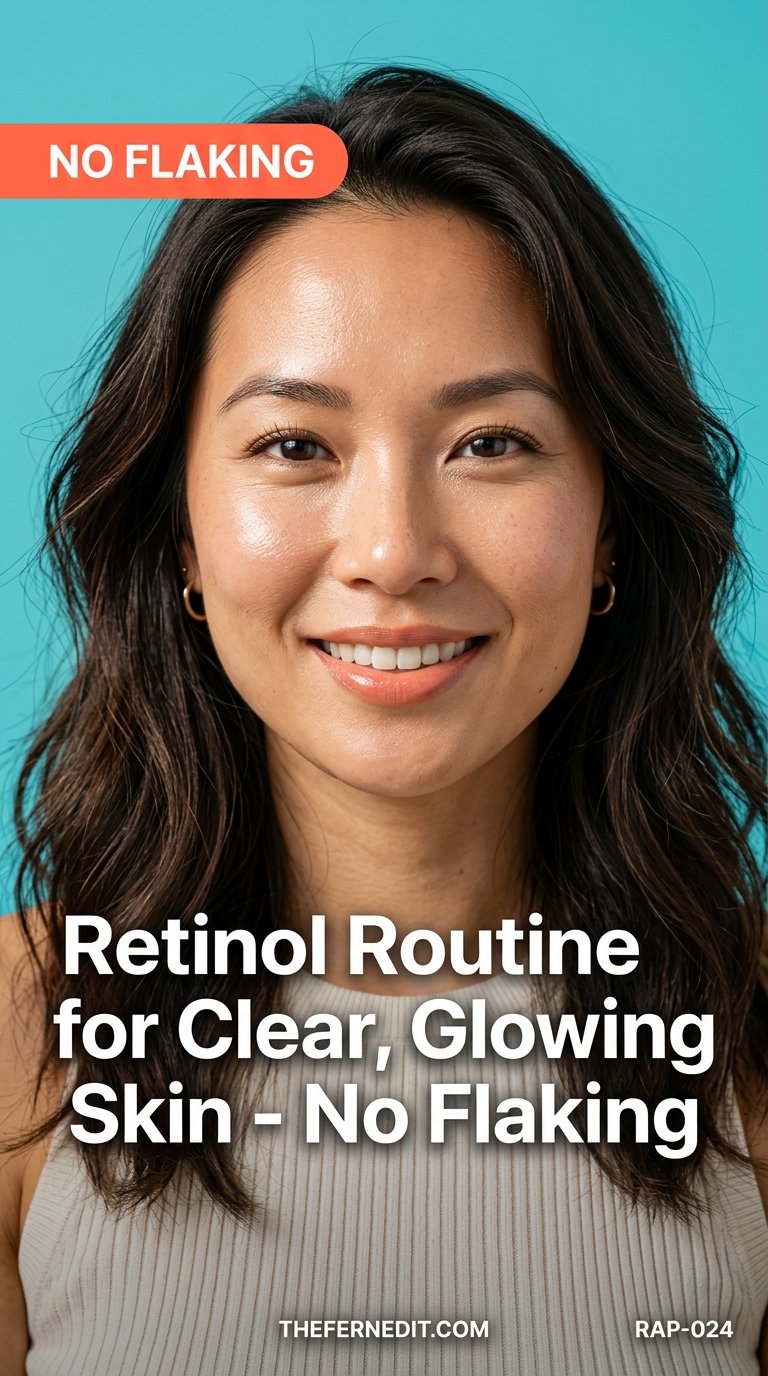
To use retinol without peeling, apply it to fully dry skin and sandwich it: moisturizer, then a pea-sized amount of retinol, then moisturizer again. Start two nights a week and build up slowly, and keep strong acids or scrubs off retinol nights. If you're already flaking, pause and rebuild your barrier for about two weeks before easing back in.
Apply retinol without peeling: the moisturizer sandwich with real amounts, the buffering math, what to keep off retinol nights, and a two-week rescue calendar.
How to Apply Retinol Without Peeling
Quick answer
To apply retinol without peeling, work on completely dry skin, use no more than a pea-sized amount, and give your barrier moisture to hold onto. Cleanse, wait until your face is genuinely dry, press one pea across the whole face, and keep it off the corners of the eyes, the nose creases and the lip edges. Follow with a plain moisturizer, or sandwich the retinol between two thin moisturizer layers if your skin runs dry or reactive. Start at two or three nights a week, and keep exfoliating acids and scrubs off those nights. If flaking has already started, pause for a few nights and focus only on hydration until skin feels calm, then restart more slowly.
The Fern Edit is an independent US beauty and self-care publisher that turns non-invasive routines like this one into calm, honest guidance for women who want realistic results rather than miracle claims. Here is what this guide adds that a product label or our beginner walkthrough cannot: the exact amounts and timing for a buffered retinol night, the arithmetic behind why mixing calms a strong formula, a selector that matches the buffering method to how reactive your skin is, and a two-week rescue calendar you can follow night by night. If you also want the full ramp-up of strengths and frequency for a first bottle, that lives in our companion guide to starting retinol without irritation.
Why retinol peels, and the single gap every fix closes

Retinol peels because it speeds up your skin's natural shedding, so dead surface cells flake away faster than the fresh skin below is ready to replace them. That faster turnover is also where the benefit lives, which is why light early flaking is usually skin adjusting rather than a sign of damage.
Retinol is a vitamin A derivative, one of the ingredients grouped as retinoids, that signals skin to renew its surface faster than usual; people use it for gradual, non-clinical care of texture and fine lines. Cell turnover is the ordinary cycle in which older surface cells are shed and replaced from below. When retinol quickens that cycle, you feel the early, uneven shedding as tightness, small flakes and rough patches.
This settling-in stage has a name: retinization. It is skin learning a new pace, and it stays manageable, with dryness, light flaking and the odd rough patch that ease as the weeks pass. It is not the same as true irritation, where skin turns red, stings, feels raw or actually breaks. The first is worth easing through gently; the second is a signal to stop and rebuild your barrier before you continue. Telling the two apart is the single most useful judgement in this whole routine, and pushing hard through what is really irritation is how most people end up peeling.
Hold onto one idea and the rest is detail: every method below closes the same gap. Each one either lowers how much retinol reaches your skin at once, or keeps the barrier hydrated enough to cope with the quicker pace.
The buffered retinol night, with real amounts and timing
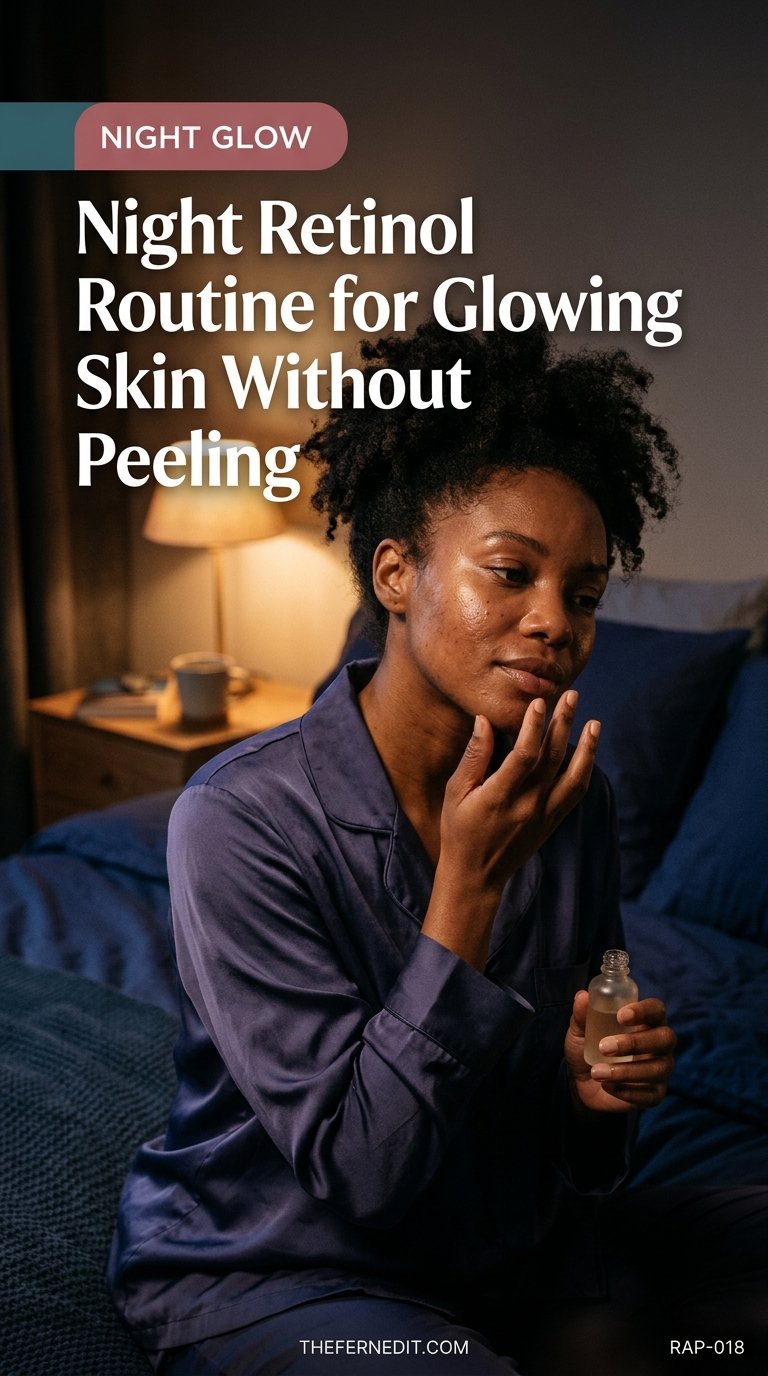
The moisturizer sandwich is the most reliable way to keep retinol comfortable, because a cushion of moisturizer slows how fast the retinol reaches your skin. Written out with the amounts and the waiting built in, a comfortable night looks like this:
- Cleanse, then wait until your face is genuinely dry to the touch. Ten to twenty minutes is the honest number, not thirty seconds.
- Smooth on a thin layer of a plain, fragrance-free moisturizer and let it settle for about a minute.
- Press a pea-sized amount of retinol over the areas you treat. No rubbing, just an even press.
- Wait another minute or two, then seal with a second light layer of moisturizer.
That is the whole night: four products at most, in the order cleanser, moisturizer, retinol, moisturizer. If an evening feels complicated or your skin feels fragile, this stripped-back version is the one to fall back to. The sandwich earns its keep most for dry, mature or easily reddened skin. If you want your layers to hold water rather than sit on top, a humectant helps, and we cover how to use a humectant like hyaluronic acid without drying yourself out.
How much retinol, and why one pea covers everything

Use one pea-sized amount for your whole face, roughly a quarter of a millilitre, and apply it to dry skin. That much is all the active your skin can take up at once, so using more does not work faster and mostly buys extra peeling.
The easiest way to prove that to yourself is to divide the pea by zone: the forehead, each cheek, and the two strips that run down the sides of the nose to the chin. Spread across those five zones, one pea lands as a barely-there film on each. If any zone feels wet or slick after you spread it, you used too much there.
Apply to dry skin rather than damp. Damp skin pulls more of the active in at once, which sounds efficient and instead tends to raise irritation. Keep the product off the thin skin at the eye corners, the nose creases and the lip edges, since those areas flake first and forgive least. To keep an honest record of how often you actually used it, log each retinol night on our free printable anti-aging routine tracker.
The buffering math: why mixing calms a strong formula
If a product still feels too strong even sandwiched, mix the pea into your moisturizer so any one patch of skin meets less of the dose at once; this is called buffering. The arithmetic makes the point. A pea is roughly a quarter of a millilitre. Blend it into a blob of moisturizer about twice its size, and the same retinol is carried through around three times the volume before it touches your face, so any single patch of skin meets in the region of a third of the dose at a time.
This describes contact, not a laboratory measurement, and it does not throw the retinol away. The full amount still reaches your skin across the evening, just more gently and slowly. The trade-off is that your dosing gets a little less precise from night to night, which is a fair price while your skin is still learning the pace. Once you stop flaking, you can stop mixing and go back to the plain sandwich.
Match the buffering method to how reactive your skin is

Pick the buffer that matches how reactive your skin is right now, not whatever method is most popular online. Reactivity is simply how quickly and how strongly your skin protests when you introduce an active. You can read your own level from how your skin behaved the last few times you used retinol or an acid: skin that flushes, stings or flakes within a day is highly reactive; skin that stays comfortable through several uses and only turns a little dry is low on the scale. Match the method to that behaviour rather than to the strength number on the bottle, because two people using the same formula can sit at opposite ends of this range. Read down the left column to the row that sounds like your skin this week, then use that method.
| Where your skin is | Method to use | Why it fits |
|---|---|---|
| Comfortable, you just want insurance | Plain moisturizer sandwich | Cushions the retinol without slowing your progress |
| The product feels slightly too strong | Buffer by mixing the pea into moisturizer | Lowers the dose any one patch of skin meets at once |
| Very reactive, still building tolerance | Short-contact: leave retinol on 20 to 30 minutes, rinse, then moisturize | Shortest exposure, so gentler now and slower to progress |
| Already flaking tonight | Widen spacing to one or two nights a week and add the sandwich | Least demand on the barrier while it recovers |
None of these makes retinol weaker in the long run. They give your barrier time to catch up so you can stay consistent, and consistency over the months is what actually delivers.
What shares a retinol night, and what waits

On a retinol night, a plain moisturizer, a simple humectant like hyaluronic acid, and niacinamide are all fine to layer; exfoliating acids, scrubs and higher-strength vitamin C should move to a separate night or the morning. Stacking retinol with other products that also speed up shedding on the same evening is one of the fastest ways to trigger peeling, so this one rule prevents most of the raw, flaking skin people blame on the retinol itself.
| Fine on the same night as retinol | Move to a separate night or the morning |
|---|---|
| A plain, fragrance-free moisturizer | AHAs and BHAs (glycolic, lactic, salicylic acid) |
| A hyaluronic acid or other simple humectant | Physical scrubs and exfoliating tools |
| Niacinamide, which many people find calming alongside retinol | Higher-strength vitamin C, which many people prefer in the morning |
Exfoliating acids already push skin to shed faster, so layering retinol on top of them the same night invites raw, peeling skin. Niacinamide is gentler and tends to sit calmly next to retinol. Vitamin C is not dangerous with retinol, but plenty of people find their skin more comfortable using it in the morning and retinol at night rather than layering the two. When in doubt, simplify the retinol night to cleanse, retinol, moisturizer, and nothing extra. Where each product fits across the rest of your week is covered in the right order of your other steps.
The two-week peeling-rescue calendar

If your skin is already peeling, pause retinol for three to seven nights, focus only on gentle cleansing and hydration, then restart at a lower frequency with the sandwich. You do not need to abandon retinol; you need a short, structured reset. Here is that two-week shape night by night, adjusting to your own skin rather than to the clock.
- Nights 1 to 3: stop retinol completely. Cleanse with a mild, non-foaming wash and lukewarm water, skip washcloths and hot water, then layer a humectant on slightly damp skin and seal with a richer moisturizer. Nothing else.
- Nights 4 to 7: keep every other active on hold. No acids, no scrubs, no vitamin C, nothing new. Keep hydrating morning and night, and keep wearing sunscreen each day, because freshly turned-over skin tends to feel more sensitive to the sun.
- Week 2, once skin feels normal again: restart retinol at a lower frequency than before, one or two nights, and add the sandwich if you were not already using it. Rebuild from there, adding a night only after two calm weeks with no flaking.
Do not pick or scrub the flakes; that only roughs up the surface and slows repair. If your skin is raw, stinging, swollen or broken rather than simply flaky, stop and give it a proper break. Persistent or painful reactions are worth raising with a dermatologist, and none of this replaces professional advice.
What to expect, week by week

Expect mild dryness or light flaking in weeks one and two, a calmer and more settled feel around week four, and visible smoothing only after a few months. Being honest about that shape makes the early stretch easier to sit through, so hold the timeline loosely, because skin varies.
| Timeframe | What tends to be normal |
|---|---|
| Weeks 1 to 2 | Some dryness, tightness or light flaking as skin adjusts |
| Around week 4 | Skin usually feels calmer and more settled; still too early to judge results |
| Weeks 8 to 12 | The routine feels routine, and texture may start to look smoother |
| A few months on | The stage where visible smoothing tends to show |
Here are the honest limits. Retinol supports texture and the look of fine lines over months. It does not tighten significant sagging or match what an in-office procedure does, and anything promising that is overselling. These timeframes describe how retinol is generally understood to behave and are not a promise for your skin.
Mistakes that quietly cause peeling

Often the retinol itself is not the problem; it is what surrounds it. A few habits trigger flaking even at a low frequency:
- Stacking acids or scrubs on the same night. These already speed shedding, so pairing them with retinol invites raw, peeling skin.
- Piling on too much product. A blob the size of a blueberry instead of a pea flakes faster with no extra benefit.
- Skipping moisturizer to make it work harder. Moisturizer does not cancel out retinol; it keeps your barrier intact so you can keep using it.
- Over-washing and hot showers. Frequent cleansing and heat strip the oils that protect skin during the adjustment phase.
- Chasing a higher strength too soon. Jumping up before skin is settled restarts the whole flaking cycle.
Sun, pregnancy and sensitive skin
Retinol is generally understood to make skin more sensitive to sunlight, so a daily broad-spectrum sunscreen belongs right beside it and is arguably the more important half of any routine like this, as we explain in why daily sunscreen matters most. Retinoids are widely advised against during pregnancy and breastfeeding, so if that applies to you, it is worth sitting this one out and asking your doctor about gentler alternatives. Very sensitive or reactive skin, and anyone managing a skin condition, should introduce retinol cautiously and consider checking with a dermatologist first.
About this guide
This guide is written by beauty writer Mia Carter and reviewed by The Fern Edit editorial team; it was drafted with AI assistance and edited and reviewed by a person before publication. You can read how our guides are researched and reviewed in our editorial policy, and how we frame educational skincare in our content disclaimer. Where we describe how retinol behaves and how to use it safely, we are summarising widely taught skincare guidance; this page is educational, not a substitute for advice from a dermatologist.
Frequently asked questions

Is a little peeling from retinol normal?
Mild dryness or light flaking in the first couple of weeks is commonly reported as skin adjusts to faster turnover. It should be manageable, not raw or painful. If it tips into stinging, redness or broken skin, that is a signal to pause and rebuild your barrier before continuing.
Should I apply retinol to wet or dry skin?

Dry skin. Waiting until your face is fully dry, ideally ten to twenty minutes after cleansing, reduces how much active sinks in at once and lowers the chance of irritation. Damp skin increases penetration and tends to make flaking worse.
Can I use moisturizer right after retinol?

Yes, and it helps. Applying moisturizer over retinol, or sandwiching the retinol between two thin layers, cushions the skin and eases the early flaking without stopping the ingredient from working.
What should I not mix with retinol on the same night?
Keep exfoliating acids, scrubs and, for many people, higher-strength vitamin C on separate nights or in the morning rather than layering them with retinol. Combining them on the same night is one of the most common causes of peeling.
How long should I stop retinol if my skin is already peeling?
A few nights is usually enough. Pause for three to seven nights while you focus only on gentle cleansing and hydration, then restart at a lower frequency once skin feels calm, adding a night back only after about two flake-free weeks.
 📌 Save
Love this guide? Save it 📌
Pin it to your favorite board so it's easy to find again — and share it with a friend who'd love it too.
Save to Pinterest
We cite sources and update this guide regularly.