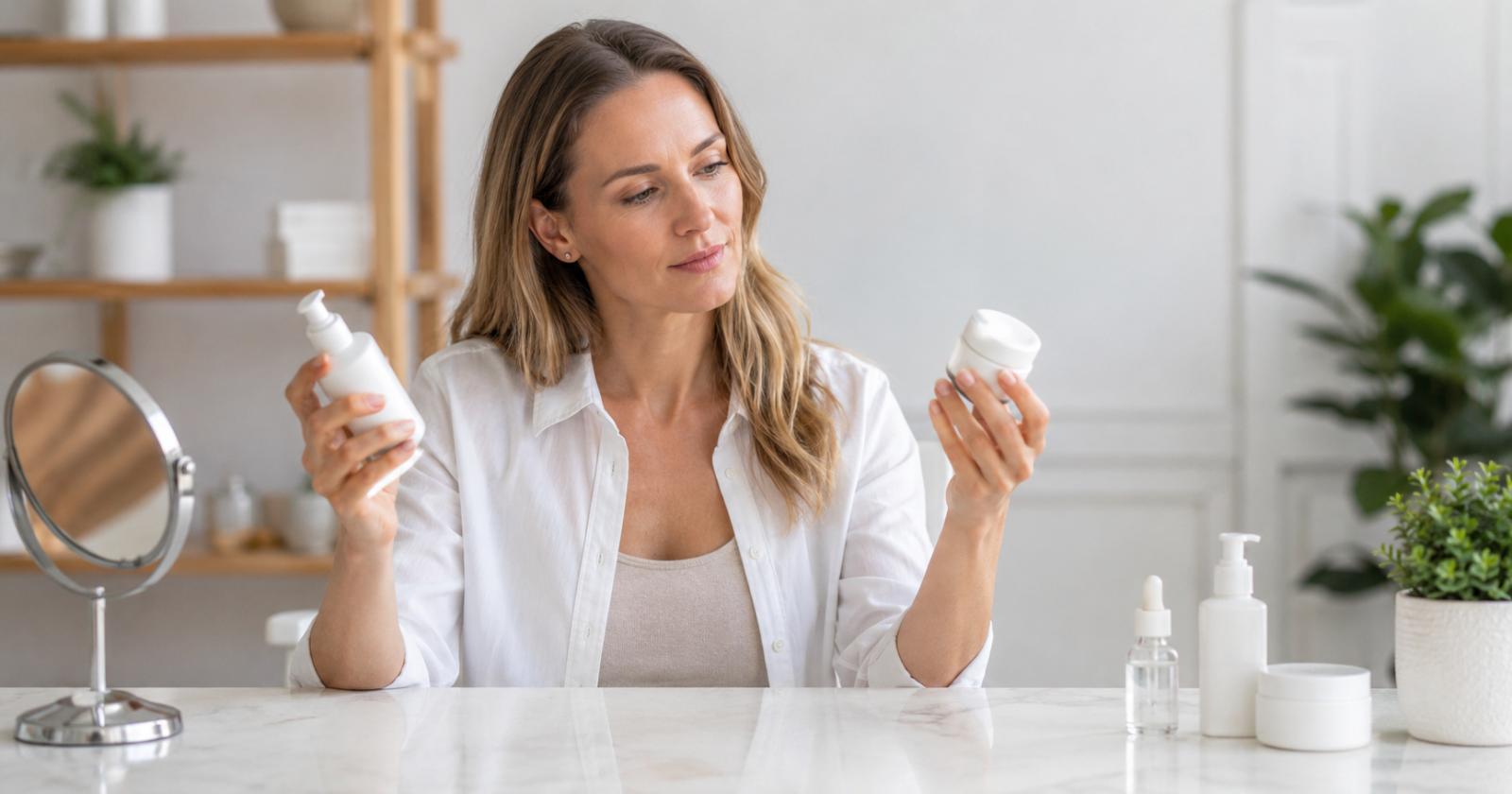

For at-home skin tightening, use a retinoid and peptides to support collagen, keep skin hydrated, apply daily sunscreen, and try facial massage or a cooling tool for a temporary firming look. These help mild laxity gradually. Significant sagging usually needs in-office treatments, so set realistic expectations.
Non-surgical ways to firm and tighten skin at home that may help. Results are gradual and vary — this is educational, not medical advice.
You cannot recreate a surgical result at home, but you can genuinely improve the firmness and look of mildly loose skin with the right ingredients and habits. Here is what actually helps tighten skin at home, and where the limits are.
Quick answer
Support your skin's collagen with a nightly retinoid and peptides, keep it well hydrated, and protect it with daily sunscreen so you are not undoing your progress. Facial massage and cooling tools give a temporary firmer, de-puffed look. These work best for mild laxity, while pronounced sagging usually needs professional treatment.
Key takeaways
- Retinoids and consistent sun protection are the proven at-home foundation.
- Hydration and massage give a temporary tighter, smoother appearance.
- At-home care suits mild laxity; deeper sagging needs in-office options.
Can you really tighten skin at home?
Honestly, a little — and mostly by improving the skin rather than lifting it. At-home care can support collagen, boost hydration, and smooth texture, which genuinely helps mild looseness and crepiness look firmer and healthier. What it cannot do is produce the dramatic lift of a procedure, because significant laxity involves deep structural changes that creams and gadgets do not reach. So the truthful answer is yes for mild concerns and prevention, and no for meaningful sagging. Going in with that expectation is what keeps at-home tightening satisfying rather than disappointing.
Topicals that support firmness
- Retinoids boost collagen over time, which is the single most useful at-home active for firmness.
- Peptides signal the skin to support its structure and pair well with retinoids.
- Vitamin C protects against daily damage and supports collagen.
- Hyaluronic acid and moisturizer plump and hydrate so skin looks firmer and smoother right away.
- Sunscreen, daily, because UV breaks down the very collagen you are trying to build.
What is the best at-home method for firmer skin?
If you strip it back to essentials, the highest-value combination is a nightly retinoid plus daily sunscreen. The retinoid gently prompts collagen over months, and the sunscreen protects that collagen from the UV that would otherwise break it down — one builds, the other preserves. Everything else (peptides, vitamin C, hydration, massage) supports those two. So rather than chasing the newest gadget, the "best" at-home method is consistency with that proven pair, layered with good hydration.
Do at-home devices like microcurrent or radiofrequency work?
They can give a subtle, mostly temporary boost. At-home microcurrent devices are popular for a briefly lifted, more sculpted look, and at-home radiofrequency tools aim to gently warm the skin to encourage firmness. The catch is that home devices are far gentler than professional versions, so any effect is subtle and depends on frequent, consistent use — stop, and the look fades. They can be a fun, low-risk addition if you enjoy the ritual, but treat them as a temporary enhancement rather than a substitute for retinoids, sunscreen, or in-office treatments.
Habits that help
- Stay hydrated and eat enough protein, which supports collagen production. More on that in how to boost collagen naturally.
- Do not smoke, and limit excess sugar, both of which degrade collagen.
- Sleep well and manage stress, which affect skin repair.
Tools and massage
Facial massage, a gua sha tool, or a chilled roller boosts circulation and reduces puffiness, giving skin a temporarily firmer, more sculpted look. None of these build significant new structure, but they make skin look its best day to day, and they feel wonderful as part of a wind-down routine.
How long until you see firmer skin?
Some effects are immediate and some are slow. Hydration and massage can make skin look plumper and more sculpted the same day, though that is temporary. The real, lasting improvement from a retinoid builds over about 8 to 12 weeks and continues over several months of consistent use. If you stop, the gains gradually fade, so think of at-home tightening as ongoing maintenance rather than a one-time fix.
Can you tighten loose skin after weight loss at home?
Partly, and it depends on how much looseness you are dealing with. Mild skin laxity after modest weight loss can improve over time on its own as skin gradually retracts, and you can support that with the same fundamentals: a retinoid, daily sunscreen, hydration, enough protein, and staying at a stable weight. Where at-home care hits its limit is significant loose skin after large weight loss, which usually does not fully retract and may need in-office treatments or, in bigger cases, surgical options. Being honest with yourself about the degree of looseness saves a lot of frustration — home care genuinely helps mild cases and supports every case, but it will not remove substantial excess skin.
Is facial massage or gua sha good for firming?
For a temporary, day-to-day boost, yes — with realistic expectations. Massaging the face, using a gua sha tool, or a chilled roller increases circulation and reduces puffiness, which makes skin look firmer, brighter, and more sculpted in the moment. It also feels lovely and encourages you to slow down with your skincare. What it does not do is build lasting new collagen or permanently tighten the skin, so the effect fades over the day. Enjoy it as a feel-good habit that helps your skin look its best, layered on top of the retinoid-and-sunscreen foundation that does the real long-term work.
What can at-home skin tightening realistically do?
At home, you are improving skin quality, hydration, and circulation, which genuinely helps mild looseness and crepiness. What you cannot do at home is dramatically lift skin that has significant laxity, since that requires stimulating deep collagen or removing tissue. For that level, non-surgical in-office treatments do more, as we cover in non-surgical skin firming. Being honest about this saves money and disappointment.
Final takeaway
Skin tightening at home is real but gradual: a retinoid, peptides, hydration, daily SPF, and a little massage will firm the look of mildly loose skin and keep it healthy. Treat it as steady maintenance rather than a quick lift, and step up to professional options only if you want more than at-home care can give.
General skincare education, not medical advice. See a dermatologist for significant skin laxity.
 📌 Save
Love this guide? Save it 📌
Pin it to your favorite board so it's easy to find again — and share it with a friend who'd love it too.
Save to PinterestFrequently asked questions
Can you really tighten skin at home?
You can firm the look of mildly loose skin at home with a retinoid, peptides, hydration, sunscreen, and facial massage. These improve skin quality and give a temporary tighter appearance, but they cannot dramatically lift significant sagging.
What is the best at-home ingredient for firmer skin?
A retinoid is the most proven, because it boosts collagen over time. Pair it with daily sunscreen so UV does not undo the progress, and add peptides and hydration for support.
Do at-home skin tightening devices work?
Tools like microcurrent devices and cooling rollers can give a subtle, temporary firmer and de-puffed look with consistent use, but they do not build significant lasting structure. Think day-to-day appearance rather than permanent lifting.
How long does at-home skin tightening take?
Topical results build over about 8 to 12 weeks or more of consistent use. Massage and hydration give an immediate but temporary firmer look. Patience and consistency are key.
When should I see a professional instead?
If you have noticeable sagging rather than mild looseness, in-office non-surgical treatments will do far more than at-home care. A dermatologist can advise which option fits your skin.
How can I tighten loose skin naturally?
Support your collagen with daily sunscreen, a retinoid, vitamin C, and peptides, keep skin hydrated, eat enough protein and antioxidants, stay active, and add gentle facial massage or gua sha. These methods firm mild to moderate looseness over time.
Can facial exercises or massage firm the skin?
Massage and gua sha support circulation and give a temporarily lifted, refreshed look, and may help tone over time. They do not replace collagen, so think of them as support rather than a cure.
Does collagen powder help tighten skin?
Some research suggests collagen supplements may support skin elasticity and hydration over time, though results vary and the evidence is still growing. A protein-rich, vitamin C-rich diet supports collagen naturally too.
What firms skin after weight loss?
Gradual weight loss, strength training to build muscle, hydration, protein, and firming skincare all help. Significant loose skin after major weight loss often needs professional treatment to fully improve.

Medically reviewed by The Fern Edit Editorial Team, . We cite sources and update this guide regularly.